How to Choose Optics for Your AR 15
Accessory AR optics come in a wide variety of styles. Here's how to get the right optic for your gun
Robert Sadowski
• 13 min read
Deciding which optic is best for your AR comes down to what you intend to use the AR for—defense, hunting, or long-range shooting—and if your AR is equipped with iron sights. The next thing to consider are the types of AR optics: dot-style reflex sights, prism sight/scopes, and variable-power riflescopes. I’m also including a fourth type of optic: the digital hybrids that are used for specific scenarios. All of these AR optics have pros and cons. Let’s take a look at which optic is best-suited for your AR and the type of shooting you intend to do.
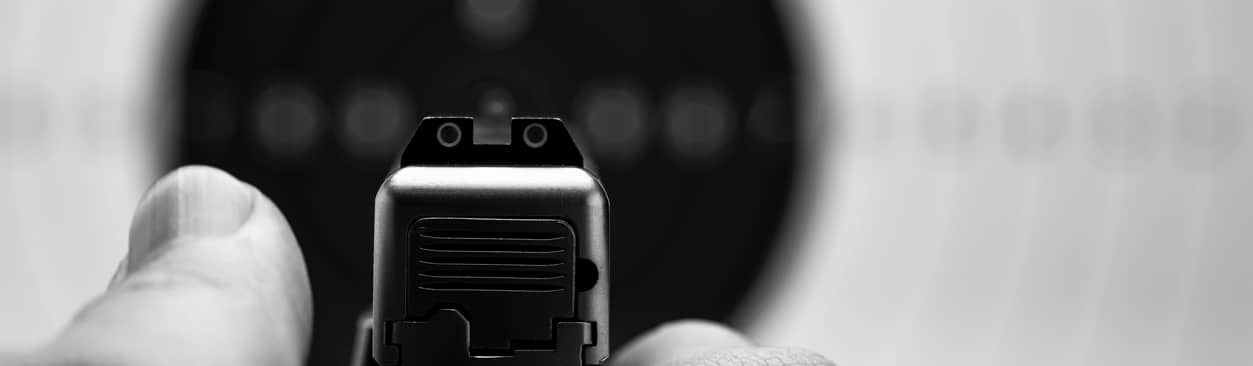
Iron Sights
The AR rifle was designed to be fired using iron sights. The fixed A2-style front sight, which was originally standard equipment on military-issued M16 rifles circa the early 1960s, still has a following today. The AR carry handle, which housed the rear sight, evolved to a flat top receiver equipped with a Picatinny rail in modern ARs. This modern upper receiver is by far the most popular with users since it offers the ability to easily mount a variety of optic types.
What are the advantages of AR iron sights? If your optic is damaged, iron sights offer a backup. Iron sights are redundant to optics, and that can mean the difference between aiming your AR versus pointing your AR when your optic goes sideways. If you have a fixed A2 front sight, your best optic choice is a dot-reflex sight or a prism scope, since it can co-witness with the optic. Back Up Iron Sights (BUIS) are designed to fold flat and flip up when the optic goes down. The drawback of iron sights used in conjunction with optics is the iron sight tends to block some of the field of view. This is no real problem if your shots are at close range, but when you put distance between you and your target, the sight picture can become cluttered.
Next, let’s take a look at the three classes of AR optics.
Dot-Style Reflex Sights
Reflex sights, also known as dot sights or red-dots, use a dot reticle that the user places on the target to take the shot. Dot-style reflex sights have an edge in close-quarter situations because the dot is easy to focus on. Reflex sights offer fast target acquisition and are best-suited for defense work. Depending on the type of hunting you do—say, hunting pigs from a blind at under 75 yards—a dot sight excels. Reflex sights have no magnification and unlimited eye relief, so it is like using iron sights except easier, since you only focus on the dot, not on aligning a rear and front sight. Most quality reflex sights are also parallax-free and offer consistent sighting. Better reflex sights offer automatic dot-brightness adjustment depending on the lighting in the environment. In my opinion, this allows the user to focus on the target rather than fussing with the sight.
Reflex sights are compact and lightweight, and have a small footprint, so they don’t add extra weight or bulk to your AR. They are powered by batteries you can buy at a convenience store or gas station. Premium reflex sights have features built in to conserve battery life. Some models turn off after a period of inactivity and immediately turn back on when picked up. I have had sights that sip battery juice and last for years.
Reflex sights pair well with backup iron sights. The iron sights co-witness (see FAQs below) with the dot, so you are always ready even if your dot sight batteries are DOA.
Dot reticles come in a variety of sizes and colors. We tend to call all dot-style sights “red-dot sights” since these sights were originally designed with a red dot. Today, there are green-dot reticles as well as some that are blue. I suggest viewing different-color dot sights side-by-side and choosing the color that best works with your eye. Dot size ranges from 2 MOA (minute of angle), 3.5 MOA, to 4 MOA. Small reticles are easier to use at farther distances; large dots tend to obscure the target at farther distances. At close range, large dots offer fast target acquisition. Some reflex sights offer BDC (bullet drop compensation) -style reticles with holdover points for long-range shooting.
Most reflex sights come with a Picatinny mount, so installing one is fast and easy. Reflex sights tend to be the least expensive option for an AR optic.
Prism Riflescopes
Think of a prism riflescopes as a step between a dot-style reflex sight and a variable-power riflescope. Prism riflescopes combine the dot-style reticle of a reflex sight with the magnification of a variable-power riflescope.
Traditional riflescopes use a series of lenses to focus on a target. A prism scope uses a glass prism to focus on the target. Prism scopes are more compact than a traditional scope, yet have many of the same features, such as fixed magnification, an etched reticle that is illuminated, and a focusing eyepiece. Compared to a reflex sight, a prism scope is heavier and less compact.
In my opinion, premium prism scopes have one big edge over reflex sights: They are battery-free. They get powered by a fiber optic that juices a tritium reticle and automatically adjusts the brightness of the reticle depending on available light.
The magnification on a prism scope is fixed, and the range is from 1.5X up to 5.5X power. For medium-range distances, a 3X, 3.5X, or 4X power magnification is the sweet spot. Many prism scopes are rugged and made for hard use. In fact, the first rifle combat optic adopted by the U.S. Marine Corps was a 4X power prism scope. They are well-suited for defense work as well as medium hunting ranges.
Prism scope reticles typically come in three colors: red, green, and amber. The reticle type on a prism scope can be a dot, chevron, crosshair, horseshoe dot, or triangle.
Prism scopes can also be used with iron sights, as most units will co-witness with iron sights. Nearly all prism scopes attach to a Picatinny rail, so mounting one to your AR is a snap.
Premium prism scopes for AR rifles are not inexpensive, though there are quality brands that won’t cost more than your AR rifle.
Variable-Power Riflescopes
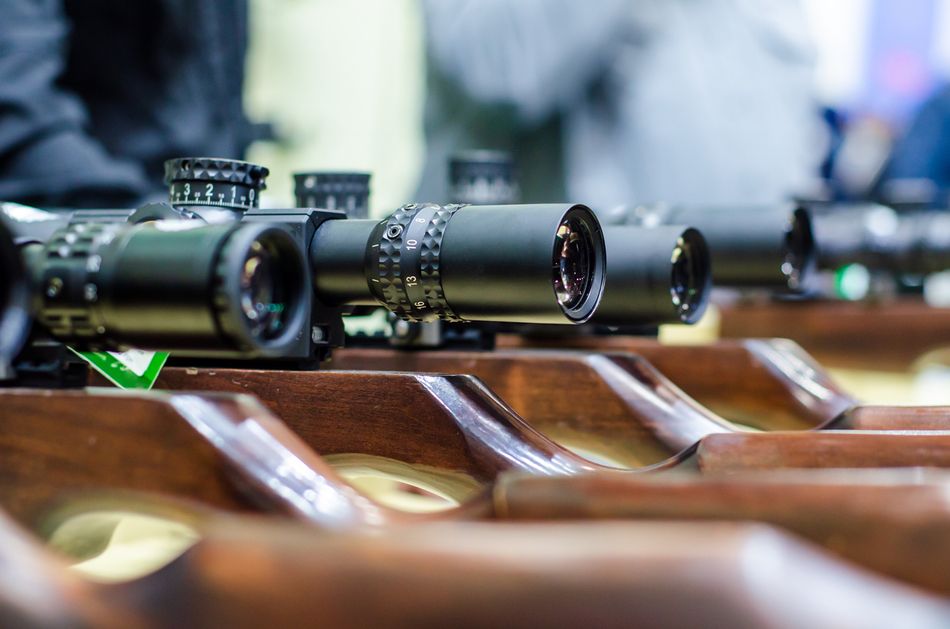
Variable-power riflescopes are just as at home on an AR as they are on a bolt-action rifle. These scopes offer zoom magnification, a variety of reticle types, the ability to judge distance, and more.
These scopes use exposed or covered turrets to adjust the reticle. Typically, tactical-style scopes have exposed turrets, so the user can quickly adjust the zero on the scope to a specific distance. Covered turrets are typically used by hunters who zero the scope for a specific distance and never touch it again.
Depending on the magnification zoom, variable-power scopes are well-suited for close- to long-range shooting. If you want a variable scope to act like a red-dot for close range yet have the ability to hit targets at distance, a 1-3X power scope is your best option. I suggest a scope with an illuminated reticle and a large diameter tube so you will have a wider field of view and fast target acquisition. Nearly all 3-Gun competitors use a 1-3X power scope, dialing it down for close target work and cranking up the magnification for targets farther away.
Many variable scope brands also offer reticles calibrated to the caliber of your AR, so if you shoot 5.56, 6.8 SPC, .300 BLK, or any other caliber, there is no guesswork, as the distance between subtensions is calibrated for specific distances.
If your intent is long-range shooting, then a scope with a higher-magnification range is the option for you. The higher the magnification range, the better you can see your target. The only drawback is as you zoom in on the target, you decrease your field of view. Zoom in too much and take a shot, and you might have a hard time getting back on target after recoil, so decrease the magnification.
Another consideration when selecting a variable-power riflescope is a first focal plane (FFP) or a second focal plane (SFP). An FFP scope reticle changes in size with adjustments in magnification, so subtensions remain constant. This means holdover and ranging can be used throughout the full magnification range of the scope. FFP scopes are well-suited for precision rifle shooting and long-range hunting. SFP scopes are the most common, and nearly every hunting rifle is equipped with this reticle. An SFP reticle maintains its size during changes in magnification. Something to note with an SFP scope is that the ranging or trajectory-compensation systems can only be used at a specific magnification setting.
Reticle types for a mid- to high-magnification scope are typically an MRAD (Milli radians) or MOA design that allows the user to judge distance to a target. The reticle works in synch with the turret clicks, so zeroing the scope is easy, repeatable, and consistent. Reticle choices range from the simple to the complicated. Choose a simple reticle, such as a duplex crosshair, for hunting or a mil dot if you want to judge distances. More complicated reticles look like a sheet of graph paper, but once you understand how they work, you will find you can compensate for wind and adjust for distance almost instantly.
Variable-power scopes are heavier and require rings or an AR-specific mount to attach them to an AR. Fixed or backup iron sights do not work with variable-power scopes. So, your AR needs to be free of iron sights and optic-ready.
Digital Hybrid Optics
These scopes have night vision or thermal sights built into the scope. They also have mini computers to record video as well as help calculate trajectory to the target. Night vision or thermal scopes are a must-have for night hunting for feral pigs or predators. These scopes can also be used in daylight. Typically, thermal and night sights are expensive.
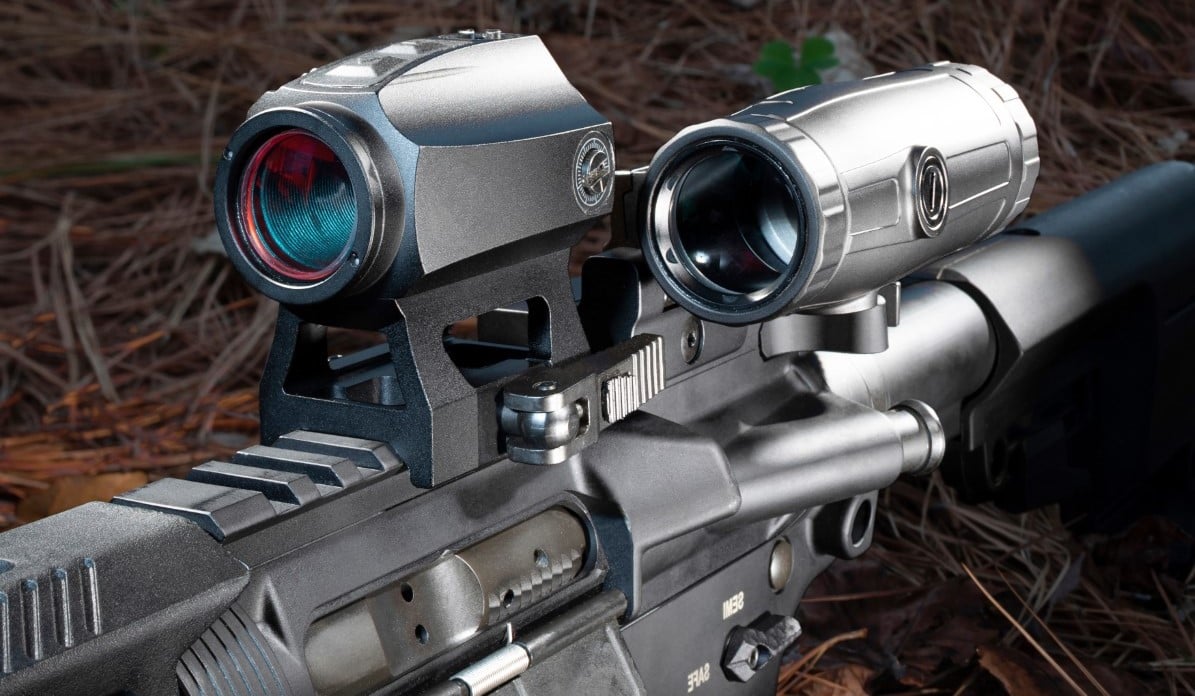
Other hybrid AR optics include pairing a reflex sight with a flip-to-side magnifier for long-range shooting. Another option is to offset mount a small dot sight on a variable-power scope. Use the scope for a medium- to long-range shot and tilt the rifle to use the dot sight at close range. Some sights can also be paired with night vision.
Conclusion
There’s a plethora of AR optics on the market. Most AR scopes fall into one of three categories: dot-style reflex sights, prism riflescope, and variable-power riflescopes. There are also hybrid AR optics designed for specific situations. Use dot-style reflex sights for targets at 0 to 100 yards, when speed is the priority. Consider a prism riflescope for targets from 50 to 400 yards. For distances farther out, opt for a variable-power riflescope. And if you have a specific need, like night hunting, try a hybrid digital sight.
FAQs
Q: Red-dots vs. holographic sights: What’s the difference?
A: Both types of sights use light beams, but in different ways. A dot-style reflex sight uses an LED emitter that projects a beam onto a coated glass lens, which is reflected back to your eye so you can see the dot reticle. A holographic sight uses a laser and a series of mirrors to send a hologram image to your eye that appears to be in front.
Q: What does co-witness mean?
A: Co-witness refers to the alignment of an optic sight with iron sights. When the optic’s reticle, say a red-dot, aligns with the iron sights, the two sights work together as co-witness sights. AR co-witness sights provide backup in the event your optic fails. There are two types of co-witness sights: absolute and 1/3. Absolute co-witness means the dot and the iron completely align when you aim. With a 1/3 co-witness, the optic reticle is above the iron sights, so the user views more of the optic reticle—the iron sights are in the bottom 1/3 of the optic.
Q: What is an optics-ready AR?
A: An optics-ready AR means that the upper receiver on the AR rifle or carbine is equipped with a Picatinny top rail for mounting a variety of optics, such as dot-style reflex sights, prism scopes, and variable-power scopes.