How to Get into Long-Range Shooting
Want to hit melon-size steel plates at 1,000 yards? Join the legions of shooters hooked on this chal
Wayne van Zwoll
• 19 min read
Late in 1873, after trouncing England and Scotland to take the Elcho Shield at Wimbledon, Irish riflemen had challenged the U.S. to a long-range match. Each of six men per team would fire 15 shots at 800, 900, and 1,000 yards. With just months to prepare, no rifles for such an event, and no place to host it, the Amateur Rifle Club of New York accepted. The NRA and the cities of New York and Brooklyn each raised $5,000 to build a range on Long Island’s Creed’s Farm, secured by the State. We call it Creedmoor.
September 26, 1874, rolled up hot for the Grand International Rifle Match. Late that afternoon the event came down to the last shot from the American team. John Bodine was allowed a sip of ginger beer. As he opened the bottle, it broke. A shard sliced his trigger hand. What timing! This next bullet would be the most important of his life! A crowd of 8,000 fell silent as Bodine bellied down with his Remington.
Bodine squinted into the sights. The .44-90 belched smoke. Seconds later cheers drowned the whock! on the 3x3-foot iron bull’s-eye. America had won, 934-931, with a shot sent more than half a mile!
Although long-range shooting was then well established in Great Britain, rifle matches stateside were rooted in a hunting culture, in battles decided by lead balls. Even powerful “buffalo rifles” did their work at sure-kill range. Powder was precious; lost animals were lost revenue.
There’s an ethical component to hunting that argues against long shots at game, but slapping steel out yonder is great fun — and a challenge! It’s fast making enthusiasts of casual shooters. A decade ago, fewer than 200 competitors fired a handful of long-range matches in the U.S. Now venues have multiplied to host more than 15,000 shooters of all ages, backgrounds, and skill levels.
The Games
Since rifling appeared in the 16th century, shooters have tried to stretch accurate reach. These days, accuracy is now defined by the size of groups from consecutive shots in minutes of angle (1 MOA = 1.047 inches at 100 yards, 2.094 at 200, and so on). Hunters may aspire to “1-minute” accuracy. In IBS (Benchrest) competition, groups are tiny. During a 2007 IBS match, Tom Sarver sent five bullets into 1.403 inches at 1,000 yards! That .14-MOA knot over such distance through variable air currents was all the more amazing because it was centered, scoring 50-5x, and fired from a rifle in the “Light Gun” category. Short months later, Joel Russo used a heavier rifle to nip a .44-MOA group at 1,680 yards!
Less exacting than Benchrest matches are long-range steel-target games. One of the earliest came about in Mexico in 1948, when, as the tale goes, iron livestock stood in for beleaguered beasts picked off by bandits raiding farms. Siluetas Metalicas migrated to Nogales, Arizona, in 1967. Originally a hunter’s course, it’s fired offhand at chickens (200 meters), pigs (300), turkeys (385), and rams (500). Other target sizes and distances have followed, for “cowboy” rifles and rimfires.
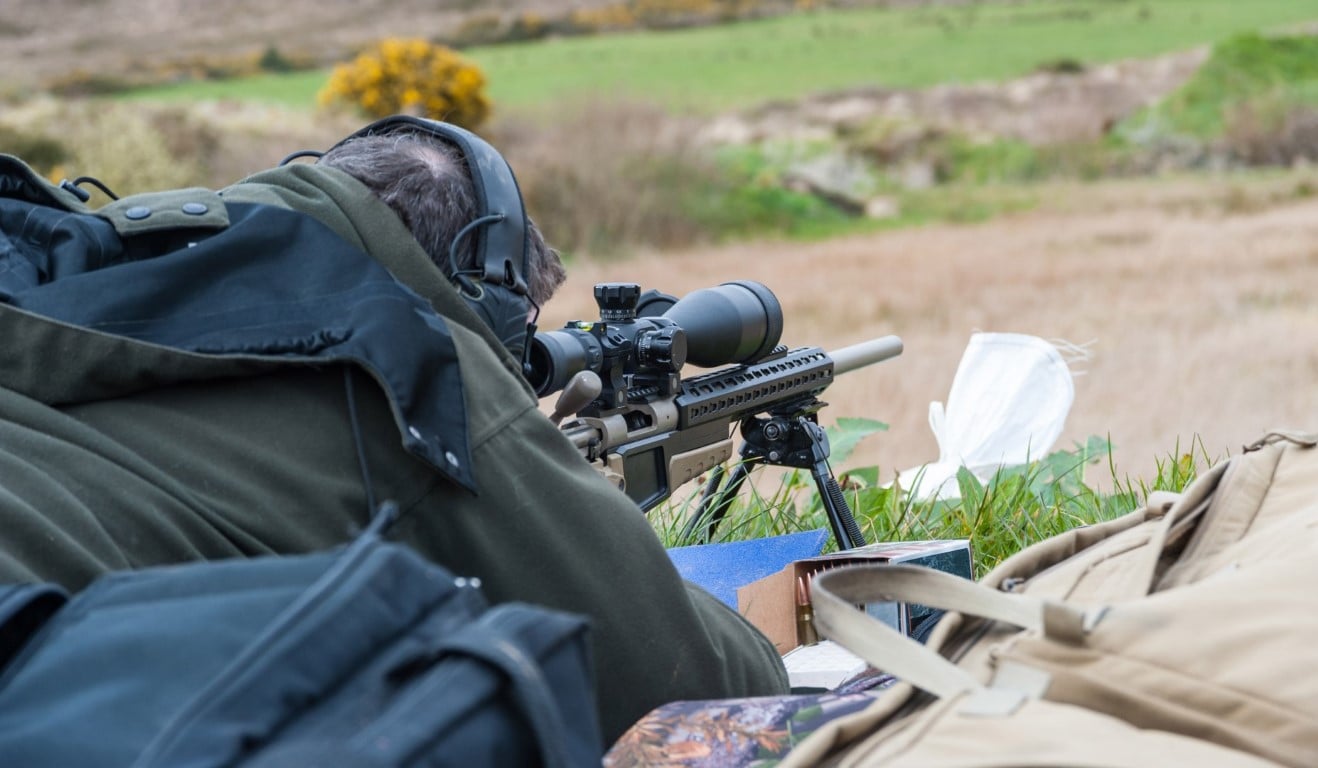
Now there’s a stampede to PRS (Precision Rifle Series) matches. There’s no mandated course of fire. Dedicated ranges to four-figure distances are expensive to buy and maintain. Shared use of rangeland and farm fringe is more practical, makes the best use of local terrain, and brings conditions hunters meet afield. Targets 1 to 3 MOA in size can be set at distances and in places dreamed up by the host club. They can be camouflaged or partly shielded. Shots may come at steep vertical angles or into the sun. Shooters are sometimes denied a place to “go prone,” so they must improvise rifle support or fire from unsupported positions. Range and wind calls are up to the shooter. Matches typically include 14 to 21 stations, with shooting times of 30 seconds to 5 minutes at each, depending on target layout and the number of shots required. In some matches, shooters pair up, alternately firing and spotting as a team.
PRS, a U.S. entity, became an affiliate of the PRF (the international Precision Rifle Federation) when it appeared in 2021. The National Rifle League runs similar matches, mostly in Western states. The NRL has no rifle divisions. Bolt rifles and self-loaders in chamberings from 223 Remington/5.56 NATO to .300 Winchester Magnum are permitted, bullet speeds not to exceed 3,200 feet per second (fps). PRS has Open, Tactical, and Production Divisions for bolt-actions, and a Gas Gun Division for autoloaders. Bullets up to 7.62mm (.308) in diameter at speeds to 3,200 fps pass muster in the Open Division. Additional rules apply to others. Rifles in the Production Division must be commercially sold at a price no greater than $2,500. Scopes have a retail cap of $2,000.
The Rifle
Long ago I shot my first Metallic Silhouette match, and placed, with a Mauser in .270 Winchester under a 6X Pecar riflescope. The winner used a .30-06 Springfield Winchester Model 70 and a Weaver K4 scope. But “silhouette rifles” soon appeared, with big scopes. That evolution is repeating in PRS competition. As the targets are small, most of them far off, you need a rifle that drives nails when you’re prone over a bipod, but one nimble enough for fast, accurate fire from other positions and improvised rests. Matches can include hikes over hills between firing points, so the rifle must be of reasonable weight and sling-equipped for easy carry. Its trigger must break crisply and consistently at a manageable weight: 2½ pounds for me.
Surging interest in long-range shooting has brought on a fresh cohort of rifles so purposed. You’ll find match-ready bolt-actions from $900 to $1,800. Savage’s 110 Ridge Warrior, for instance, and Ruger’s RPR fit the bill here. Others worth a look include Tikka’s T3x in UPR and Compact Tactical versions. Howa’s APC Flag and Mossberg’s MVP Precision rifles are affordable chassis-style models. I’m a sucker for good looks, so I am sweet on Sauer’s S100 Pantera and FieldShoot. Weatherby’s AccuMark and CarbonMark series now include rifles stocked for long-range events. The AR-15 gets equal attention from riflemakers courting the long-range market.
An adjustable comb and butt aren’t necessary, but the stock must align your eye quickly with the scope’s axis, especially from prone. You must be able to relax into it and cycle the action without pulling the rifle off target. I prefer a conventional stock to chassis versions. An Arca-Swiss plate on the forend is the best way to install a bipod, especially if you plan to move or detach it during a match. Area 419 makes an Arca-compatible clamp for a Harris bipod (my choice).
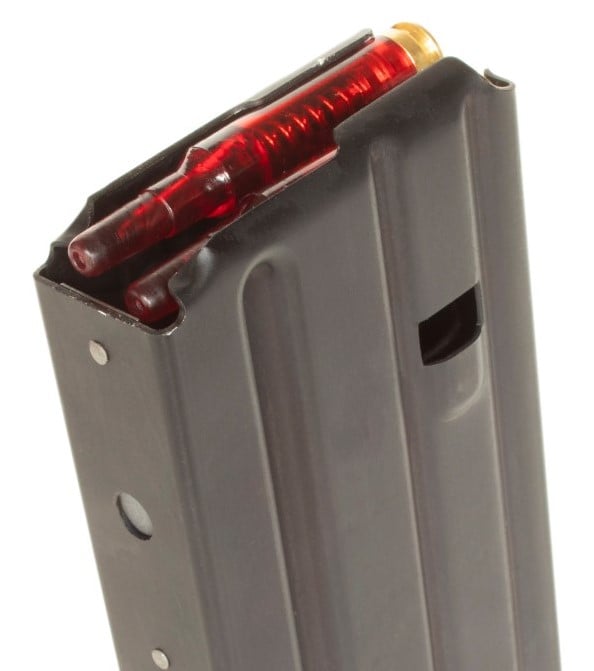
One station may require up to 10 shots. As magazine changes burn time, 10-shot AICS mags are popular at PRS events. Accurate Mag has a 3-inch box to accommodate leggy match bullets in the .308 and kin. Two additional cartridges in loops on your stock near the bolt knob can save you after a fumble, misfire, or malfunction. A caveat: Long-range matches can mandate single loading, so a block or pouch to ready ammo for no-look reloads makes sense. Consider chamber access, too. I once lost points with a rifle whose small port hampered cartridge insertion from my thick fingers.
A muzzle brake tames recoil, sparing you bruises and a flinch. Reduced muzzle jump helps you see bullet strikes and gets you back on target quickly. Still, even with muffs and ear plugs, I prefer quiet rifles. Suppressors mitigate recoil almost as well as brakes, but without radial ports that annoy shooters beside you or, prone, blow dust into your eyes.
Loads
To excel at distance, you’ll need fine marksmanship and bullets that defeat drag and drift. Excess bullet speed and energy punish you in recoil, affecting shot execution. Top PRS shooters use cartridges of modest capacity, like the 6.5mm Creedmoor and 6.5x47mm Lapua, the 6mm Creedmoor and 6mm XC. They’re designed for long-nose boat-tail bullets of high ballistic coefficient. Sent at 2,700 to 3,000 fps, 103- to 108-grain 6mm Creedmoor and 130- to 147-grain 6.5mm Creedmoor bullets don’t beat you up. Match loads from Hornady and Federal perform exceedingly well. Other able cartridges with a broad selection of match bullets and loads include the .308 Winchester/7.62 NATO, though it’s friskier in recoil.
Some of the most efficient long-range bullets from Berger, Hornady, and Nosler have G1 ballistic coefficients of well over .600. These often require sharper rifling twist than is standard for the cartridge. Choosing a bullet can thus affect your choice of rifle or barrel. Twist rate can determine your best bullet.
Optics
A high-power riflescope helps you see small targets far off. Bright, sharp, flat images keep your eyes comfy over hours of shooting. Fully multicoated optics (each lens surface coated to better transmit light) are now standard on high-quality scopes. To focus the target and nix parallax error (apparent target shift if your eye moves off the scope’s axis), insist on a focus/parallax dial.
While variable power is arguably overrated in hunting scopes, it’s useful in PRS matches, so you can dial down in thick mirage or up to refine aim at small plates. A 6–18X scope has all the power settings you’ll likely use on distant steel. For most targets, 10X to 14X works well.
Most scopes sold in the U.S. have a second- or rear-focal-plane reticle. It appears a constant size across the power range. A first-plane reticle “grows and shrinks” with magnification changes. But it stays the same size relative to the target, so can be used as a rangefinder at all power settings. Also, with an FFP reticle, power changes cannot affect point of impact.
The “trajectory-matched” elevation dial popular with hunters can bring hits in long-range events, too. This dial is marked for a bullet of known ballistic coefficient at known starting speed. When zeroed at 100 yards and aiming at a 600-yard target, you just spin the dial to “6” and hold center. Dials cut for me by Greybull Precision on Leupold VX-3s have 1/3-MOA clicks, for more shift per rotation than with 1/4-minute. An elevation dial should have a resettable zero, and a zero-stop limiting dial travel.
A scope base with “gain,” typically 20 MOA up at the rear, can help you. That tilt keeps your aim in the scope’s optically superior center at distance, and gives the dial more reach. PRS shooters also want a bubble level on the scope. A slight tilt to your rifle can send your bullet inches off target out yonder.
You won’t need an illuminated reticle (or a pie-plate front lens) because long-range matches take place in good shooting light. You won’t want a reticle with a spider-web of fine graduations you’ll strain to see and double-check while the clock ticks.
Reticles, Minutes, and Mils
Scope reticles and windage and elevation (W/E) dials are marked in minutes of angle or in mils. Most MOA dials move impact 1/4 inch per click at 100 yards. But a, MOA is 1.047 inches at 100, so it is not 10 inches at 1,000 yards but 10½. Second-decimal digits matter in corrections of several minutes!
European scope dials have traditionally hewed to the metric system, each click 1 centimeter (cm) at 100 meters (109 yards). A cm is about .36 inch, or 1/3 minute. Also customary: Dial rotation is opposite that of U.S.-built scopes. “Up” and “right” are clockwise turns on many scopes from the Old Country.
“Mil” is not short for “military.” It’s an abbreviation for milliradian, an angular measure spanning 1/6400 of a degree, or 3.6 inches at 100 yards, 3 feet at l,000. A mil-dot reticle has a series of dots, each typically 3/4 inch in diameter, spaced along a crosswire at 1-mil intervals. Given a front-plane reticle or, on a scope with a second-plane reticle, a specified power setting (usually the highest), mil dots can help you range a target and correct for bullet drop and drift.
To use a mil dot reticle as a rangefinder, divide target height or width in mils at 100 yards by the number of spaces subtending it. The result is range in hundreds of yards. Example: A target 3 feet high (10 mils at 100 yards) appears in your scope two dots high. Divide 2 into 10—you get 5. The target is 500 yards away. You can also divide target size in yards by the number of mils subtended, then multiply by 1,000. For our sample target: 1 divided by 2 multiplied by 1,000 equals 500.
Dials in mils can pull your zero from near to far and back with fewer spins than can MOA dials. At PRS matches, most shooters talk in mils—something to keep in mind when buying a scope.
W/E adjustments must move point of impact in predictable increments repeatably. To check your dials, fire three-shot groups “around the square” at one mark on big paper at 100 yards. After the first trio, dial 20 clicks right and shoot another. Add 20 down, fire. Move 20 left, fire. Come 20 up, fire. Last shots should be with the first. Groups aren’t exactly 5 inches apart? Despair not. Just note the actual values (W and E may differ), so when you run dials during a match, point of impact will go where you wish.
Accessories and The Help Desk
There’s no end to gadgets hawked to help you hit at distance. Consider them carefully—you must carry your kit! All but the rifle goes into my heavy-duty daypack: ammunition, extra magazines, bipod, rain gear, tools, muffs, extra ear plugs, and shooting bags of various shapes and sizes. These help support the rifle against trees, on posts, and across tree limbs. Armageddon Gear sells rectangular and cylindrical toe bags for prone shooting. Its 5-pound Game Changer front bag has a “sticky” surface that gloms onto rails and other obstacles. Hiking between stations, heavy bags have all the appeal of heavy rifles. I prefer small bags like Wiebag’s 1-pound Tac Pad. S2Delta’s versatile, affordable 1-pounder has a removable pack of plastic pellets. Caldwell lists a 1½-pound Mini X-Bag whose fingers help keep it in place, and a Tack-Driver rectangular bag with elastic straps and squishy pellets. Bison Tactical’s Skinny Boy Udder Bag straddles rails and limb. Use it upside-down on the bench.
Shooting a long-range course solo, I don’t carry a spotting scope. But a shared spotter on a two-man team makes sense. Powerful glass helps the stand-by shooter call wind and mirage and bullet strikes. Use a sturdy carbon-fiber tripod with an Arca-compatible ball head, per the CF series from Athlon Optics.
While shooters in the Creedmoor match of 1874 could hardly have imagined digital smartphones with ballistic apps, PRS shooters rely on them. Kestrel’s 5700 Ballistics Weather Meter with Hornady’s 4DOF software registers every atmospheric condition that affects bullets. It stores ballistics data for three loads and gives instant corrections for drop, drift, spin-drift, vertical angle, and even the Coriolis effect. Another option: the Bluetooth-friendly Kestrel Elite with Applied Ballistics on board.
Don’t know how to enter a match? Vague on protocols? Forget your ammo? Have no idea how wind caroming off a cliff at 800 yards will affect a bullet? Ask for help. Long-range shooters are generous with advice, encouragement, even gear—anything to put your bullets on those distant plates!
Conclusion
Long-range shooting is a fast-growing sport. To get started, you’ll need some specialized gear, such as rifles and ammo capability of shooting accurately up to 1,000 yards, high-quality optics, and a good gear pack to carry your kit over the course. But learning the game is fun, especially when you hear a metal target clang in the distance.
FAQs
Q: How about the .243 Winchester and 6mm Remington, the .260 and 7mm-08 Remington? Won’t they work as well as the 6mm and 6.5mm Creedmoor?
A: Not really. The Creedmoor cartridges are shorter, and shorter to the shoulder. They can properly grip shanks of long-nose match bullets without exceeding standard cartridge length. Shorter powder columns can bring more consistent ignition. Commercial match loads for the 6mm and 6.5 Creedmoor are readily available, and excellent.
Q: What are the most common mistakes made at long-range matches?
A: Safety protocol violations, especially those regarding muzzle control and bolt-open policies, embarrass many shooters. Many targets are missed when shooters forget to dial scopes back to zero between stations, use the wrong aiming point on the reticle, dial the wrong way, make a “full rotation” error dialing up or down, or fire at the wrong plate.
Q: I don’t have a 1,000-yard range. What’s the best way to practice for a match?
A: With an empty rifle, practice getting quickly into bone-supported shooting positions. Aim at a small mark. Control your breathing. Crush the trigger. Dry-firing won’t hurt centerfire bolt-action rifles. Now make and clearly mark dummy rounds so you can practice cycling the bolt as you would in a match. Repeat until position, aiming, firing, and cycling are second nature. A few minutes a day is better than one afternoon a month.